
This roast chicken is all about the brightness of lemon and the earthy punch of herbs. It’s a simple recipe, but when those flavors meet in the oven, it feels like a little celebration. I love how the citrus lifts the richness of the chicken, making every bite feel fresh, even after hours in the oven.
There’s something honest about a dish like this — uncomplicated, yet vibrant enough to turn a weeknight dinner into a feast. I’ve cooked it for friends who needed comfort and for myself on quiet Sundays. The aroma alone, with lemon zest and thyme bubbling up, can transform a kitchen into a little sanctuary.
It’s a recipe I turn to when I want something dependable yet special. No fuss, just good ingredients working together, filling the house with a bright, herbal scent that hints at summer even in the colder months. Sometimes, the simplest flavors are the ones that stay with you long after the plates are cleared.
Focusing on how the brightness of lemon and the earthiness of herbs can turn a simple roast into a celebration of fresh, vibrant flavors that lift the soul, especially in the quiet moments after the oven timer sounds.
Bright Simplicity in Every Bite
- This dish reminds me of childhood Sunday roasts, the kitchen filling with lemony and herbal scents that made everything feel special.
- Cooking this chicken feels like a quiet act of love — simple ingredients, honest flavors, and the joy of a meal shared around the table.
- I get a rush of pride when I see the golden, crispy skin emerge from the oven, knowing the lemon and herbs have worked their magic.
- There’s a nostalgic comfort in the tangy brightness of lemon paired with fragrant herbs, making this dish a go-to for cozy family dinners.
- Every time I make this, I feel a little more grounded, the fresh herbs and citrus bringing a bright pause to busy days.
The inspiration behind this dish
- This recipe came about during a summer visit to my grandmother’s farm. She always had a lemon tree in her backyard, and I loved how she’d throw a few zest and slices into her roast chicken, as if the citrus was a secret ingredient to happiness. One afternoon, I watched her chop herbs with a kind of quiet reverence, like she was nurturing something sacred. That moment stuck with me—simple ingredients, honest cooking, pure joy.
- Years later, I realized that pairing lemon and herbs isn’t just about flavor; it’s about capturing a feeling—bright, earthy, and real. It’s a dish that feels like a gentle celebration of everyday life, especially when the house smells like citrus and thyme. I keep coming back to it because it’s unfussy but always elevates a regular weeknight into something memorable.
- heading
- story_type
Contextual origin, trivia, or history
- Historically, roast chicken with lemon and herbs is a staple across Mediterranean cuisines, symbolizing freshness and simplicity.
- In ancient Greece, herbs like thyme and oregano were believed to have healing properties, often used in celebratory feasts involving roasted meats.
- Lemon’s journey into this dish likely traces back to Sicily, where citrus trees thrived and became central to local cooking traditions.
Ingredient breakdown: key components
- Lemon: I love using fresh, vibrant lemon zest and juice—brightens the chicken with a zesty punch. If lemons are dull or lacking juice, swap in lime for a slightly different citrus note.
- Herbs: I prefer a mix of thyme and rosemary—earthy and fragrant, they cling to the skin and infuse every bite. Swap in sage or oregano if you want a different herbal punch, but avoid overpowering the lemon.
- Salt: I use kosher salt generously—helps to draw out moisture and crisp the skin. If using table salt, cut back a bit to prevent over-salting.
- Olive oil: I drizzle with good-quality extra virgin—gives a lovely golden, crispy skin and enhances flavor. If you only have vegetable oil, it’s fine, but the skin won’t be quite as rich.
- Garlic: I toss in a few smashed cloves—adds a mellow, aromatic depth. Skip if you dislike garlic or want a cleaner, citrus-only flavor profile.
- Onion: I sometimes add a sliced onion underneath—adds a subtle sweetness and keeps the chicken moist. If avoiding onions, a splash of white wine can do the trick.
- Pepper: I finish with freshly cracked black pepper—gives a gentle heat and aroma. For a milder dish, skip or reduce the pepper.
Spotlight on key ingredients
Lemon:
- I love using fresh, vibrant lemon zest and juice—brightens the chicken with a zesty punch. If lemons are dull or lacking juice, swap in lime for a slightly different citrus note.
- Herbs: I prefer a mix of thyme and rosemary—earthy and fragrant, they cling to the skin and infuse every bite. Swap in sage or oregano if you want a different herbal punch, but avoid overpowering the lemon.
- Salt: I use kosher salt generously—helps to draw out moisture and crisp the skin. If using table salt, cut back a bit to prevent over-salting.
Herbs:
- Fresh thyme and rosemary add an earthy, fragrant aroma—dull or wilted herbs won’t infuse as much flavor. Use fresh for the best punch of herbal brightness.
- During roasting: The herbs release a fragrant, slightly smoky aroma that mingles with the lemon, creating a layered scent. They can turn crisp and slightly browned—remove if they start to burn.
- In the finished dish: The herbs cling to the skin and meat, offering bursts of herbal freshness with each bite. If you want a milder herbal note, add some at the end as a garnish.
Notes for ingredient swaps
- Lemon: I love using fresh, vibrant lemon zest and juice—brightens the chicken with a zesty punch. If lemons are dull or lacking juice, swap in lime for a slightly different citrus note.
- Herbs: I prefer a mix of thyme and rosemary—earthy and fragrant, they cling to the skin and infuse every bite. Swap in sage or oregano if you want a different herbal punch, but avoid overpowering the lemon.
- Salt: I use kosher salt generously—helps to draw out moisture and crisp the skin. If using table salt, cut back a bit to prevent over-salting.
- Olive oil: I drizzle with good-quality extra virgin—gives a lovely golden, crispy skin and enhances flavor. If you only have vegetable oil, it’s fine, but the skin won’t be quite as rich.
- Garlic: I toss in a few smashed cloves—adds a mellow, aromatic depth. Skip if you dislike garlic or want a cleaner, citrus-only flavor profile.
- Onion: I sometimes add a sliced onion underneath—adds a subtle sweetness and keeps the chicken moist. If avoiding onions, a splash of white wine can do the trick.
- Pepper: I finish with freshly cracked black pepper—gives a gentle heat and aroma. For a milder dish, skip or reduce the pepper.
Equipment & Tools
- Roasting pan: Holds the chicken for even roasting.
- Kitchen twine: Ties the legs for uniform cooking.
- Sharp knife: Carves the cooked chicken.
- Meat thermometer: Checks internal temperature for doneness.
- Basting brush: Applies pan juices or extra oil during roasting.
Step-by-step roast chicken with lemon
- Preheat your oven to 220°C (430°F). Have a roasting pan ready—large enough to hold the chicken comfortably.
- Pat the chicken dry with paper towels—this helps get crispy skin. Season generously with salt, both inside and out.
- Stuff the cavity with halved lemon wedges, a few sprigs of thyme, and rosemary. This infuses the meat with bright, herbal notes.
- Tie the legs with kitchen twine—helps the chicken cook evenly and keeps the stuffing inside. Rub the outside with olive oil, lemon zest, and minced garlic if using.
- Place the chicken breast-side up in the roasting pan. Roast for about 15 minutes at 220°C (430°F) to start browning the skin.
- Lower oven temperature to 180°C (350°F). Continue roasting for about 45-60 minutes, or until the skin is deeply golden and juices run clear.
- Baste the chicken with pan juices halfway through to enhance flavor and crispness. Keep an eye on the skin; if it’s browning too fast, tent with foil.
- Check doneness: the thickest part of the thigh should reach 75°C (165°F). The skin should be crispy and golden, with a fragrant lemon-herb aroma.
- Once cooked, remove from oven and transfer to a carving board. Let rest for 10–15 minutes—this redistributes juices and keeps the meat tender.
- Carve and serve, spooning any pan juices over the slices. Garnish with fresh herbs and lemon slices for extra brightness.
Rest the chicken on a carving board for 10–15 minutes, tented loosely with foil. Carve and serve immediately, spooning over pan juices for extra flavor.
How to Know It’s Done
- Probe the thigh: internal temp reaches 75°C (165°F).
- Skin is deeply golden and crispy, with bubbling edges.
- Juices run clear when piercing the thickest part of the thigh.
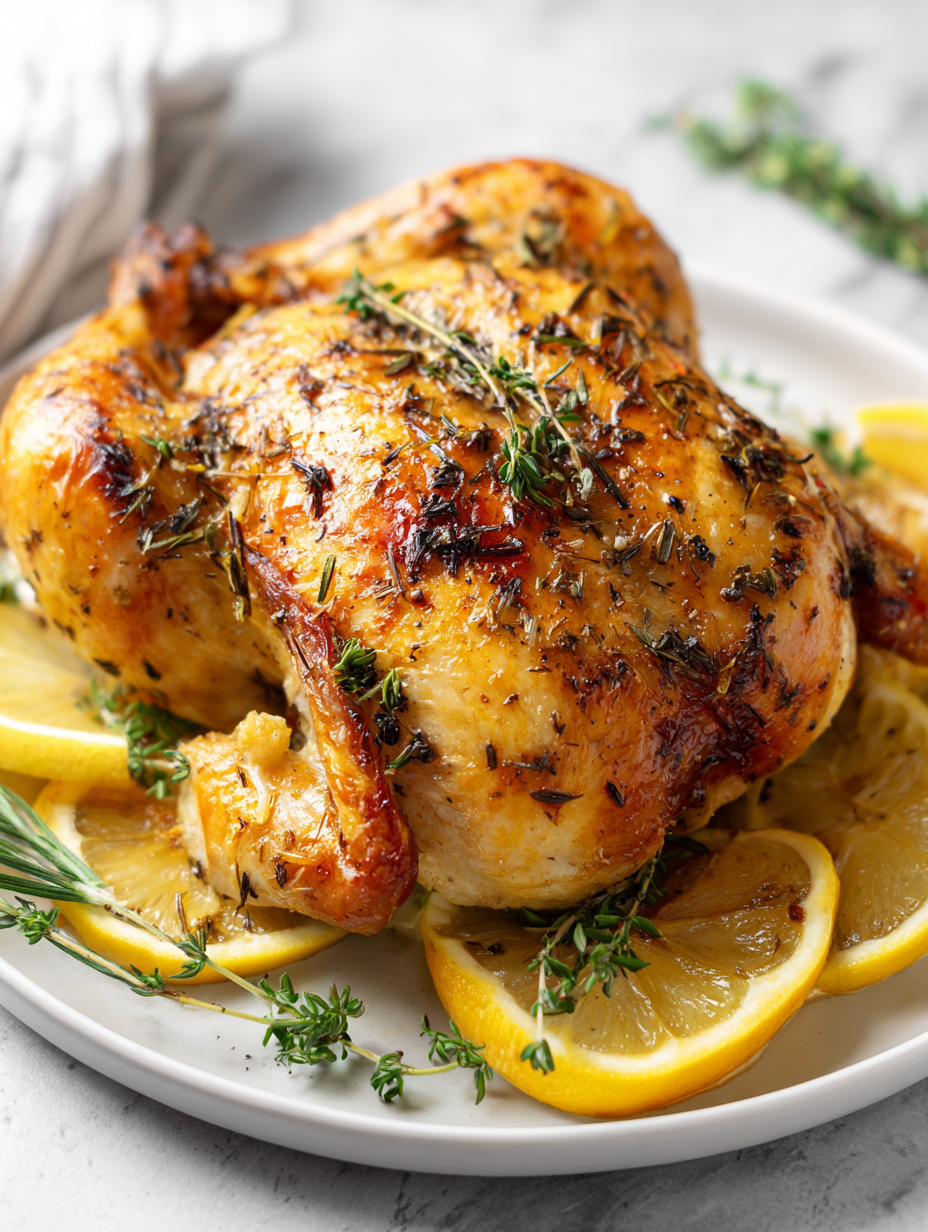
Lemon Herb Roast Chicken
Ingredients
Equipment
Method
- Preheat your oven to 220°C (430°F) and set a roasting pan nearby. Pat the chicken dry with paper towels, paying special attention to removing excess moisture from the skin—this helps it turn crispy during roasting.
- Generously season the chicken all over with kosher salt and freshly cracked black pepper, both inside the cavity and on the skin. This step ensures flavorful, well-seasoned meat and crispy skin.
- Slice one lemon in half and stuff the halves into the chicken's cavity along with a few sprigs of thyme and rosemary. This infuses the meat with bright citrus and herbal aroma as it roasts.
- Zest both lemons and rub the zest all over the outside of the chicken, then drizzle with olive oil and rub it in to promote crispness. Toss in the smashed garlic cloves and, if using, add onion slices underneath the chicken for added moisture and sweetness.
- Tie the chicken legs together with kitchen twine to help it cook evenly and retain stuffing. Place the chicken breast-side up in the roasting pan, and put it into the oven. Roast at 220°C (430°F) for 15 minutes to start browning the skin.
- Lower the oven temperature to 180°C (350°F) and continue roasting for about 45 to 60 minutes. Baste the chicken with pan juices halfway through to keep the skin golden and flavorful. Keep an eye on the skin, tenting with foil if it browns too quickly.
- Check for doneness by inserting a meat thermometer into the thickest part of the thigh; it should read 75°C (165°F). The skin should be deeply golden and crispy, with aromatic lemon and herbal scents filling the air.
- Once cooked, remove the chicken from the oven and transfer it to a cutting board. Cover loosely with foil and let it rest for 10–15 minutes to allow the juices to redistribute, ensuring tender, moist meat.
- Carve the chicken into pieces, and serve with the pan juices spooned over the top. Garnish with additional lemon slices and fresh herbs if desired, for an extra burst of brightness.
Pro tips for perfect roast chicken
- Bolded Mini-Head: Use a hot oven—start at 220°C (430°F) to quickly crisp the skin and lock in juices.
- Bolded Mini-Head: Pat the chicken dry—removes excess moisture, ensuring a golden, crackly skin after roasting.
- Bolded Mini-Head: Baste mid-roast—use pan juices or extra olive oil to enhance crispness and flavor, especially if skin darkens too quickly.
- Bolded Mini-Head: Rest before carving—let the chicken sit for 10–15 minutes to allow juices to redistribute, keeping the meat moist.
- Bolded Mini-Head: Add herbs later—if herbs start to burn, sprinkle fresh ones on during the last 10 minutes for maximum aroma and flavor.
- Bolded Mini-Head: Use a meat thermometer—check for an internal temp of 75°C (165°F) in the thigh to avoid over- or under-cooking.
- Bolded Mini-Head: Lemon zest at the end—sprinkle fresh lemon zest after roasting for a bright, citrusy burst that won’t evaporate in the oven.
Common mistakes and how to fix them
- FORGOT to pat dry the chicken—results in less crispy skin. Always dry thoroughly before seasoning.
- DUMPED too much salt—can over-salt the dish. Use kosher salt generously but avoid overdoing it.
- OVER-TORCHED the herbs—burnt herbs turn bitter. Add herbs later if roasting at high heat.
- MISSED resting time—cuts into juicy, tender meat. Rest for at least 10 minutes before carving.
Fast fixes for roast chicken
- If chicken skin isn’t crispy enough, splash with hot oil and broil for 2 minutes.
- When herbs burn, patch with fresh sprigs during the last 10 minutes of roasting.
- Dumped too much salt? Rinse chicken quickly and pat dry before roasting again.
- Overcooked or dry chicken? Rest it at least 10 minutes to retain juices.
- heading
Prep, store, and reheat tips
- Prep the chicken: Season and stuff with lemon and herbs a day ahead; keep refrigerated for up to 24 hours, the citrus aroma deepening overnight.
- Marinate early: Rub the chicken with salt, oil, and zest at least 2 hours before roasting—flavors meld better, skin gets extra crispy.
- Store leftovers properly: Keep carved chicken in an airtight container in the fridge for up to 3 days, juices stay vibrant, meat remains tender.
- Reheat with care: Warm gently in a low oven (around 150°C/300°F) until heated through, the skin crisps slightly, and the meat stays juicy.
- Flavor intensifies overnight: The lemon and herb notes become more pronounced after a day, making the dish even brighter when reheated.
Top questions about roast chicken with lemon and herbs
1. Can I use bottled lemon juice instead of fresh?
Use fresh lemon juice and zest for the brightest flavor. Bottled juice can be dull and flat, losing that zing that brightens the dish.
2. How do I know when the chicken is fully cooked?
Roast the chicken until the skin is deeply golden and the juices run clear. Use a meat thermometer to check that the internal thigh temp hits 75°C (165°F).
3. What are the key steps to getting crispy skin?
Apply a generous amount of salt and olive oil, then stuff with lemon and herbs for maximum flavor infusion and crispy skin.
4. Why is resting the chicken important?
Rest the chicken for 10-15 minutes after roasting. This allows juices to redistribute, keeping the meat tender and moist when carved.
5. Can I swap out the herbs?
Use a mix of thyme and rosemary for earthy, fragrant notes. Swap with sage or oregano if you want a different herbal profile, but keep it fresh.
6. Should I add lemon during or after roasting?
Add lemon slices or zest at the end of roasting for a fresh burst, especially if you want a more pronounced citrus flavor.
7. How do I fix soggy or pale skin?
If the skin isn’t crispy enough, broil the chicken for 2-3 minutes or splash with hot oil to crisp up the skin.
8. How should I store and reheat the chicken?
Store leftovers in an airtight container in the fridge for up to 3 days. Reheat gently in a low oven to keep the skin crispy and meat juicy.
9. What if the herbs start to burn?
If herbs burn during roasting, add fresh sprigs in the last 10 minutes or tent the chicken with foil to prevent over-browning.
10. How much salt should I use?
Use kosher salt generously, but be cautious with table salt to avoid over-salting. Adjust amount based on your salt preference and the size of the chicken.
This roast chicken with lemon and herbs isn’t just a recipe; it’s a reminder that simple flavors often shine brightest. The bright citrus and fragrant herbs create a meal that feels both fresh and comforting, especially when the season calls for something lively but familiar.
In the quiet moments after slicing, I find myself appreciating how a few honest ingredients can turn a humble bird into something memorable. It’s a dish that invites you to slow down, savor, and enjoy the small, bright bursts of flavor that linger long after the meal ends.